
By Ghost Zero
You can give a candidate for Congress $3,500 this election. That limit is set by federal law and printed by the government. Give one dollar more and you have broken the law.
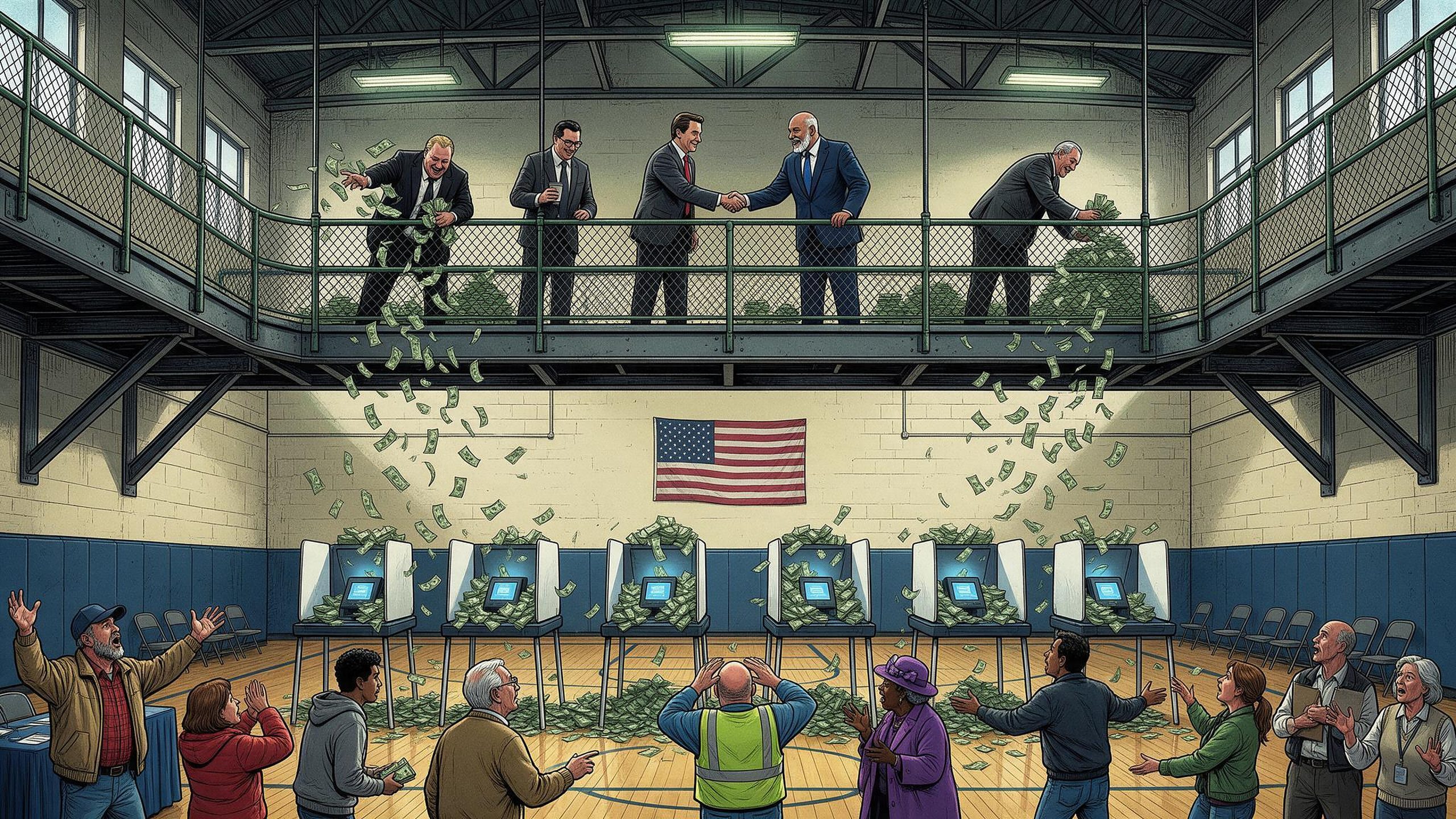
A billionaire has no limit. He can write a $50 million check to a super PAC, a political group that spends every cent helping that same candidate win. It pays for the ads, the mailers and the door-knockers. And by law, the super PAC and the candidate are not allowed to work together.
You get capped. He doesn't. That did not happen by accident. It was built, one court ruling at a time. This is how a seat in Congress gets its price.
How the Super PAC Was Born
In January 2010, the Supreme Court decided a case called Citizens United. By a vote of 5 to 4, the Court ruled that corporations and unions can spend as much as they want on political ads, as long as they do it on their own and not through a candidate's campaign. The same ruling did keep one protection for voters: groups spending that money still have to report it.
Two months later, a federal appeals court took the next step in a case called SpeechNow. Its reasoning: if a group spending on its own cannot be limited, the people giving to that group cannot be limited either.
Put those two rulings together and you get the super PAC. It can take unlimited money from almost anyone and spend unlimited money on any race. There is only one rule it has to follow. It cannot work with the candidate it is helping.
That one rule is now holding up the whole system.
The Rule Nobody Enforces
The legal word for working together is "coordination." If a super PAC plans its ads with the campaign, the law treats that money as a donation to the candidate, and donation limits kick in. On paper, it is a clear line. In real life, it only matters if someone actually enforces it.
In 2015 and 2016, a super PAC called Correct the Record backed Hillary Clinton's run for president. A watchdog group filed a complaint saying the super PAC and the campaign were working together. The Federal Election Commission, the agency in charge of enforcing these rules, split down the middle and threw the complaint out.
The watchdog took it to court. In December 2022, a federal judge ruled the agency was wrong to throw it out. He pointed out that Correct the Record never even denied working with the campaign, "perhaps recognizing the overwhelming evidence of coordination." An appeals court agreed in 2024.
Look at the dates. The court said the agency got it wrong six years after the election. The votes were counted, the winners had served, and the money was long gone.
Every person in Washington knows this is the largest legal fiction in American politics. Your vote is counted. Your voice is capped. And the seat was purchased before you ever saw a name on the ballot.
The Referee That Can't Make a Call
Think of the Federal Election Commission as the referee for campaign money. The problem is how the referee was set up.
The agency has six members. By law, no more than three can come from the same party, and it takes four votes to do anything major. In practice that usually means three Republicans and three Democrats. When a complaint lands that one side does not like, the vote can end in a 3 to 3 tie. A tie means nothing happens, and the complaint is thrown out.
That is exactly what happened when watchdogs complained about "straw donors," people or companies used to hide who the money really came from. In these cases, large sums were run through newly formed companies before landing at super PACs, including $1 million gifts to one super PAC and more than $12 million to another. The agency tied 3 to 3 and dropped the complaints. When the watchdogs sued, the courts let the tie stand, because judges give the agency wide freedom to decide which cases to pursue.
Even when the referee does make a call, look at the penalty. In one case, a brand-new company gave $1.8 million to a nonprofit called the American Conservative Union. The nonprofit then passed $1.71 million to a super PAC. The money changed hands twice before it reached the super PAC, which made it harder to trace. In 2017 the people involved settled with the agency and paid a $350,000 fine. That is about 20 cents for every dollar that moved.
Money With No Name
The middle stop in that case, the nonprofit, is where political money goes when it does not want a name attached to it.
These groups are called 501(c)(4)s, after the section of the tax code that covers them. They are supposed to be "social welfare" organizations, and the government's own rule says social welfare "does not include direct or indirect participation or intervention in political campaigns." But the IRS allows them to spend on politics as long as politics is not their main activity. The big difference is this: they do not have to tell the public who their donors are.
The courts have pushed back. In 2018, a federal judge struck down an agency rule that let groups like Crossroads GPS, which spent more than $17 million on elections, keep their donors secret. That was the disclosure promise from Citizens United finally getting enforced, eight years later.
The money keeps growing anyway. In 2020, an election year, a nonprofit called the Sixteen Thirty Fund took in almost $390 million. Its sister charity, the New Venture Fund, took in about $975 million more. Both are managed by the same firm, Arabella Advisors, which shows how much money can move through one network.
Notice the names. Crossroads GPS works for one side. The Sixteen Thirty Fund works for the other. This is not one party's problem. It is the system both parties use.
Private Money, Public Elections
In 2020, Mark Zuckerberg and his wife, Priscilla Chan, gave $419.5 million to two private groups that handed it out to election offices across the country. Private money paid to run a public election.
The rules moved too. In Minnesota, the law said absentee ballots had to arrive by Election Day. The state's top election official agreed, in a legal settlement, not to enforce that deadline. In October 2020, a federal appeals court said he likely did not have the power to make that change and ordered the late ballots kept separate. A deadline written by lawmakers had been rewritten in a courtroom deal.
And once the election is over, the spending keeps going. Companies and interest groups spent about $5.3 billion lobbying Washington in 2025. Lobbyists must report the government jobs they held before they started lobbying, because so many come straight out of government.
Then there is the scoreboard. In House races, the candidate who spends more money wins more than 90 percent of the time. Part of that is because money flows to people already likely to win, especially those already in office. But either way, a candidate without big money rarely gets a real shot.
Taking the Seat Back
Being angry will not change this. What changes it is people who stop doing only what the system expects: show up once, pick between two names that were already funded, and go home.
Look up who is funding the people on your ballot. The Federal Election Commission has a free public website, fec.gov. Type in any candidate and you can see who gave them money and how much super PACs spent for or against them. If outside groups are paying for your race, you deserve to know before you vote.
Vote in the primary. The primary is where the price gets paid, and the general election is the show. Far fewer people vote in primaries, which is exactly why money spent there goes so far.
Ask candidates, on the record, two questions. Will you support making every group that spends on elections name its donors? Will you publicly reject any super PAC working with your campaign? Their answers tell you who they plan to answer to.
Give small and give directly. A donation straight to a candidate is limited, public and tied to your name. That is how it is supposed to work.
Hold your state lawmakers responsible for your election rules. Deadlines and voting rules belong to people you can vote out, not to legal settlements you never saw.
Start tonight. Go to fec.gov, type in the name of your House candidate, and see who is paying.
I put this subject into song form, released by Vigilant Protocol as The Seat Has A Price. The 17 documents behind this brief, the court rulings, election records, tax filings and federal rules, are archived on the song's page on Protocol Media. Protocol Media is building an archive for every topic, books, briefs, music, art and short-form video, backed by the Evidence, Founding and Acts Records. The work is underway and the page keeps growing.
ART AS THE WEAPON. TRUTH AS THE AMMUNITION.