
By Ghost Zero
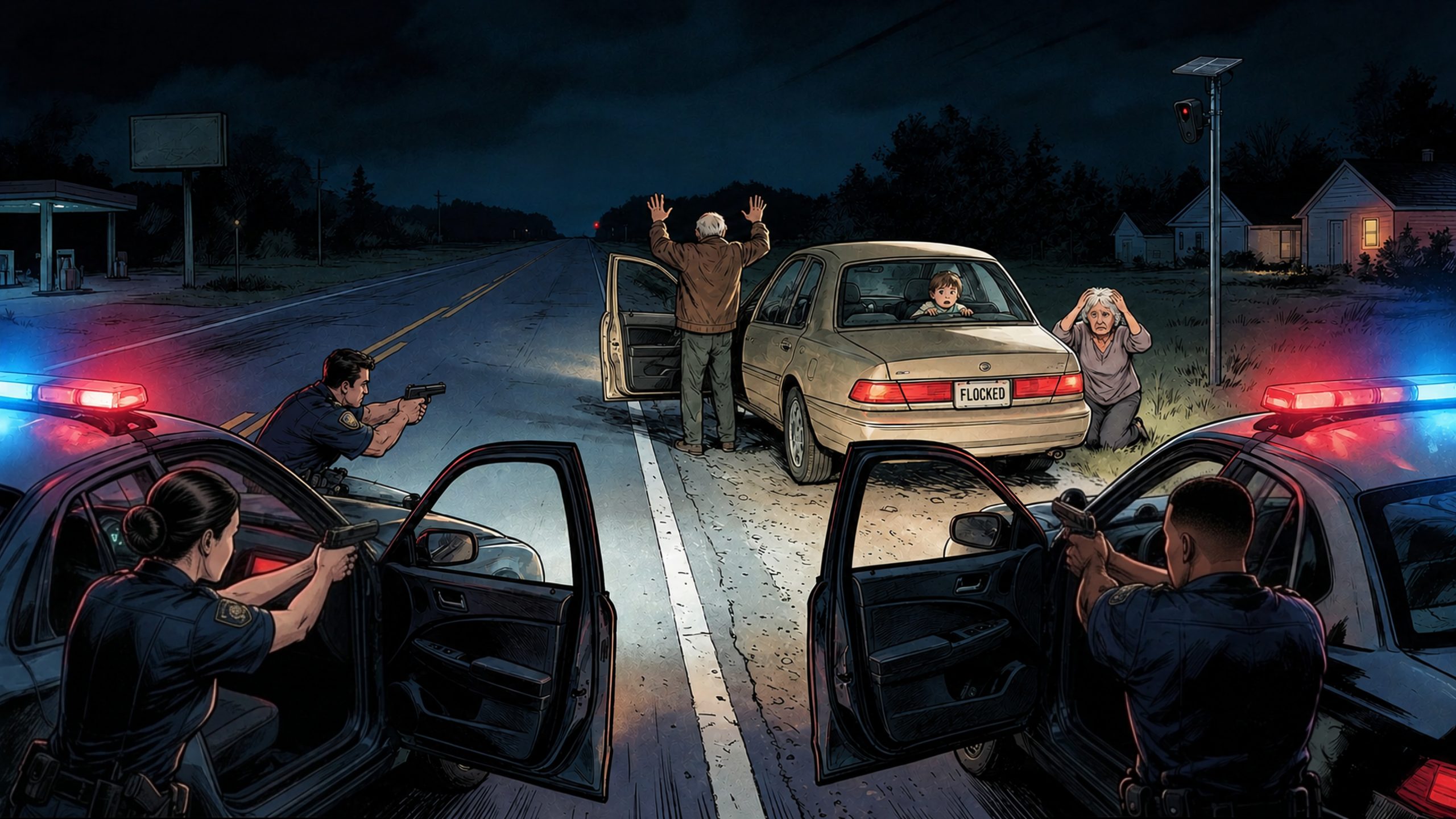
Brandon Upchurch of Toledo, Ohio was pulled over and bitten by a police dog. According to Business Insider, a Flock Safety camera read a 7 on his license plate as a 2, and that one wrong digit sent police after him. The City of Toledo settled his federal lawsuit for $35,000.
One digit. That is the whole distance between a normal drive home and a felony stop.
This is Part 2 of The Warrantless Road. Part 1 covers who built this network and who is watching through it. This part covers what happens when the machine gets it wrong, and why the officer on the street ends up holding the bag for a company's mistake.
The Cases
These are not rumors. Each one is backed by a lawsuit, a settlement, a police statement or named reporting.
– Morristown, Tennessee, 2025. JC and Carolyn Herron were handcuffed at gunpoint with their 3-year-old granddaughter in the car. Their plate read LOVEY. A stolen plate read L0VEY, with a zero. The department's own statement says that using either character, the plate came back stolen in the crime database.
– Atherton, California, 2021. Jason Burkleo says officers ordered him at gunpoint to throw out his keys and lie face down in the road for handcuffing, over a plate reader hit that did not match his plate. His federal complaint is public. Reporting says the town settled for $45,000.
– Aurora, Colorado, 2020. Brittney Gilliam and four girls, ages 6 to 17, were held at gunpoint after a plate reader matched her SUV to a stolen motorcycle from another state. Her complaint says the 17- and 12-year-old were handcuffed behind their backs. Aurora paid $1.9 million. The vendor in that case was not named.
– Sherwood, Arkansas, 2026. A Flock camera misread a plate by one letter. An officer drew his weapon on two adults with a one-month-old baby in the car.
– Redmond, Washington, 2025. Police handcuffed a father because Flock tied his car to his son's warrant. Right car, wrong man.
– Plymouth, Minnesota, 2026. Joel Feder's plate was wrongly listed as stolen because a California report went into the national crime database with incomplete numbers. Flock cameras then tracked his car for days, until four police cars boxed him in outside a store. Plymouth police confirmed the database error.
– San Diego, 2025. Police got a Flock hit on a red Alfa Romeo by make and color, with no plate. Hugo Parra and Ariel Beltran were arrested five miles from the crime. Parra spent nearly a month in jail before the charges were dropped. Both men are now suing the city.
– Florida. Lindsey Isaacs spent 13 days in jail on eight felony charges over a fatal crash. A Flock camera put her car three miles away two minutes before the crash. Her lawyers say that data should have cleared her. All charges were dropped, her lawsuit settled at mediation in September 2026, and she testified before the U.S. Senate. Flock says its data was accurate and its cameras only provide leads.
Look at the pattern. Some are bad reads. Some are bad database entries that the network then spreads to every camera. Some are a correct plate tied to the wrong person. The machine does not care which. It sends the same alert either way.
How Often Does It Happen?
Nobody knows, and that is the problem.
The Institute for Justice says there is no comprehensive database of plate reader errors. It found just one jurisdiction in the country that publishes regular reports of them: Oak Park, Illinois. IJ's own running list of plate reader errors and abuse passed 296 incidents in October 2026, and it says that list "may be just the tip of the iceberg."
Flock says its cameras achieve over 96% character-reading accuracy. That is the company's own number. When the Department of Homeland Security surveyed plate reader products in 2025, it wrote that product performance "has not been independently verified." No independent test of Flock's accuracy has been published.
Business Insider obtained Roseville, California police records showing that in 2023 and 2024, 71% of the 1,427 stolen-vehicle and felony alerts Flock sent that department were misreads. Flock disputes the figure and points to camera placement and older hardware.
None of those Roseville misreads led to a stop or an arrest. In Austin, Texas, the city auditor reviewed the program's 13,122 hotlist matches from March to December 2024 and found zero incorrect or unjustified stops in the records it checked. The difference between Roseville and Morristown is not the camera. It is whether a human being checked the plate before drawing a weapon.
The Law Already Says It
Two states have written that lesson into law.
Virginia's 2025 plate reader statute says a camera alert alone is not reasonable suspicion for a stop. Washington's 2026 law, ESSB 6002, says the same thing about a plate reader match, caps retention at 21 days, and requires a warrant to get privately held plate data.
That is not anti-police. That is the rule every good officer already follows: verify before you act. The law just stops a company's software from overriding an officer's judgment.
Does It Even Work?
Flock publishes an "Impact Census" with big crime-solving numbers. Read the fine print. Flock itself says the figures "should be read as directional estimates rather than audited totals."
A randomized experiment funded by the National Institute of Justice found that plate reader patrols in crime hot spots produced no general deterrent effect. A 2025 peer-reviewed article in the Journal of Experimental Criminology found the evidence on plate reader cost-effectiveness mixed and warned that more efficient policing is not proof of less crime.
And in August 2026, Kingston, Tennessee dropped its Flock contract. The city said "the benefits of the cameras were not worth the cost."
My opinion, labeled as my opinion: the cops in these stories are not the villains. They were handed an alert that said stolen, felony, armed, and they were trained to treat it that way. The company sells certainty it cannot prove, and when the certainty is wrong, a grandmother is in handcuffs with her granddaughter in the car and an officer is named in a lawsuit. Flock keeps the contract. The officer keeps the liability. Nobody asked me if I wanted my car logged every time I pass a pole. Nobody asked you either. I do not consent, and the right answer is to take these cameras down.
What You Can Do
The goal is removal. Not better settings, not a nicer policy. Gone.
– Tell your city council and county board, in writing and at public comment: I do not consent. End the Flock contract and take the cameras down. Mountain View, Oak Park and Kingston already did it.
– Find out when your contract renews and show up before the vote. A renewal is the easiest moment to kill it.
– If you were stopped on a camera hit, request the police report and the plate reader audit log for your plate. Keep everything. Every wrongful stop is evidence for removal.
If your town will not take them down yet, make it prove the system on every single stop while you keep pushing:
– Require written policy that an officer visually confirms the plate and state before any high-risk stop on a camera alert. Get the policy, not a promise.
– Require public reporting of every plate reader error, the way Oak Park did. If they will not count the mistakes, they cannot claim the system works.
– Ask your state legislators to pass the rule Virginia and Washington already have: a camera alert alone is not reasonable suspicion.
Safeguards are the floor, not the goal.
Start today. Search your city council's records for the words "Flock" or "license plate reader" and find out when the contract renews.
The full research is in The Flock Files: How a $7.5 Billion Startup Built America’s Surveillance Grid – and How We Stop It, free in the Red Pill Library. Part 1 of The Warrantless Road covers who built the network, who is watching through it and how exposed it is, Part 3 covers officers who abused it and the honest ones who want it checked, Part 4 covers the way out, and Part 5 covers Illinois. I also put this subject into song form, released by Vigilant Protocol as FLOCKED and by The Valkyrie Project as SMILE, with songs from Redline Republic and Axiom 312 on the way. Protocol Media is building an archive for every topic it covers: books, briefs, music, art and short-form video, backed by the Evidence, Founding and Acts Records. The work is underway and the documents are still being added, so the page keeps growing.
ART AS THE WEAPON. TRUTH AS THE AMMUNITION.