
By Ghost Zero
In January 2024, a 29-year-old paralyzed man named Noland Arbaugh became the first person to receive a Neuralink implant. A small device in his skull now records the signals from his brain and sends them wirelessly to a computer. He can move a cursor by thinking.
For a man who cannot move his hands, that is a real gift, and it should be said plainly. But notice what else just happened. For the first time, a private company is collecting a human being's brain signals, around the clock, over a wireless link.
Part 1 traced the blueprint. Part 2 followed it through the courts, where life, genes and seeds became things that can be owned. This last part follows it to the final frontier: your body and your brain as a stream of data.
The Internet of Bodies
You already know the Internet of Things, the smart speaker and the doorbell camera. The next step has a name, and its builders use it openly.
In 2019, law professor Andrea Matwyshyn defined the Internet of Bodies as "a network of human bodies whose integrity and functionality rely at least in part on the Internet." In 2020, the RAND Corporation, a research group that works closely with the Pentagon, defined an Internet of Bodies device as one that collects health or biometric data, or "can alter the human body's function."
The World Economic Forum's own 2020 paper on the subject goes furthest. It describes "an unprecedented number of sensors attached to, implanted within or ingested into human bodies to monitor, analyse and even modify human bodies and behaviour."
Read that again. Monitor, analyze, and modify. Not just your body. Your behavior. Those are not my words. They are the words of the organization that hosts Davos.
Reading the Mind
Neuralink is the famous one, but it is not alone, and it is not first.
The Pentagon's research agency, DARPA, has been working on the brain for years. In 2018 it announced a program for nonsurgical devices that can read from and write to the brain, with a stated vision: "a future in which a warfighter might control things with his or her mind, and machines can seamlessly communicate with the human brain." Another DARPA program aimed for "a fully implantable neural interface that can facilitate memory formation and recall." A third funded "neural dust," sensors about a millimeter across, tested in rats.
DARPA has also funded platforms for particles "introduced into the body" to monitor it from the inside, and paid one company, Profusa, $7.5 million to develop implantable biosensors. In its 2026 filing to go public, Profusa states: "We do not have regulatory approval to sell any of our products in the United States." The research is real. The products are not on the market yet.
Back to Neuralink. The FDA gave it "breakthrough" status, which speeds up review. The FDA says such devices "must still meet the applicable statutory and regulatory standards." And Senate investigators noted in 2025 that a federal inspector general's investigation into Neuralink's treatment of research animals was "reportedly ongoing as of January 2025." Neuralink's own granted patents cover recording, selecting and compressing brain signals at high density.
My opinion, labeled as opinion: every one of these starts with healing the sick and serving the soldier. That is how it always starts. The question is who owns the data, the device and the signal once it is inside millions of people instead of one.
Your ID, Their Platform
The body is one half. The other half is the record that says who you are.
The United Nations set a goal in 2015: "By 2030, provide legal identity for all, including birth registration." Sounds harmless. Then look at how it is being built.
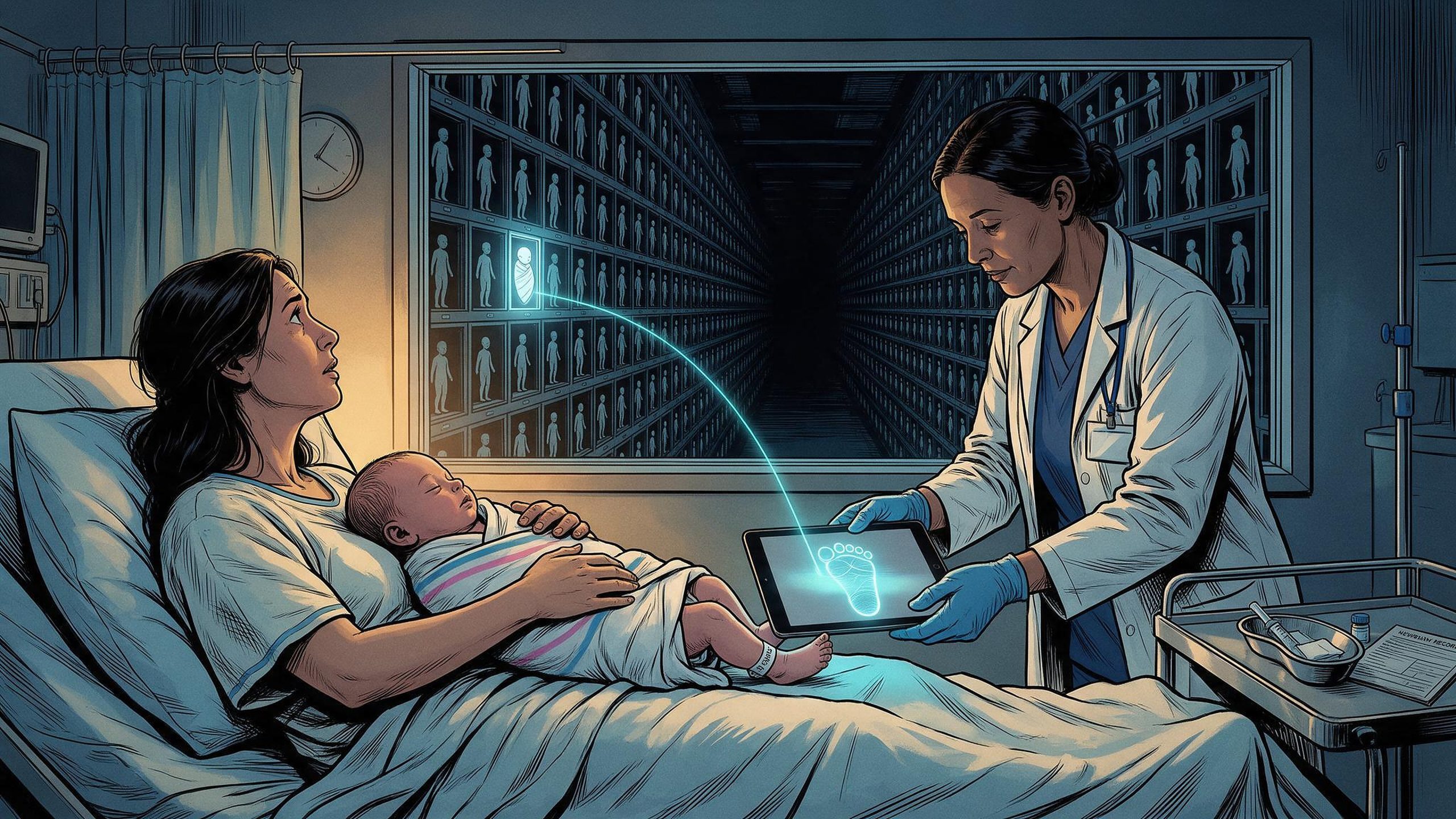
In 2019, a group called ID2020, whose partners include Microsoft, the Rockefeller Foundation, the vaccine alliance Gavi and Accenture, launched a program in Bangladesh. In its own words: "Recognizing the opportunity for immunization to serve as a platform for digital identity, this program leverages existing vaccination and birth registration operations to offer newborns a persistent and portable biometrically-linked digital identity."
Vaccines as the platform. Newborns as the users. Biometrics for life.
The World Bank runs its own ID program, launched in 2014, to build national ID systems in developing countries. To its credit, its own plan lists the risks: privacy, surveillance, "function creep" (an ID built for one use quietly spreading to others), and exclusion of people who are left out of the system.
In Europe, the new digital ID wallet law says: "The use of European Digital Identity Wallets shall be voluntary," and people who do not use it must not be disadvantaged. That line is worth holding onto. The book says the wallet leaves no way to opt out. The law, as written, says the opposite. My opinion: "voluntary" is a promise, and promises like this get tested the first time a bank, an airline or an employer decides your life is easier with the app than without it.
The Line Is Being Drawn
Here is the good news. People are fighting back, and some are winning.
– Chile amended its constitution in 2021 to protect brain activity "and the information derived from it." It was the first country in the world to do it.
– In 2023, Chile's Supreme Court ordered a company that sells brain-reading headsets, Emotiv, to delete a customer's brain data and to get express consent for any other use. The court called informed consent a protection of "the dignity of persons."
Those protections exist because someone refused to accept that their thoughts were raw material.
One more, with a warning label. In 2025, UNESCO adopted a recommendation that "the collection, processing, modification and sharing of neural data should be subject to prior, free and informed consent." Remember who founded UNESCO: Julian Huxley, the man from Part 1 who wanted the unthinkable made thinkable. My opinion: when the agency built on that philosophy writes the rules for your brain data, you don't treat it as protection. You treat it as a promise, and you hold them to every word.
The Biological Sovereign
The book ends on three rights, and they are worth memorizing: genetic integrity, neural autonomy and bodily sovereignty. Your genes, your mind and your body belong to you.
Here is how to live that out:
– Keep your body offline where you can. Before you buy a wearable, a smart ring or a health app, read who gets the data and whether it is sold. If you can't find the answer, that is the answer.
– Say no to biometric ID when it is optional, and ask whether it is optional when no one tells you. Every voluntary system needs people who actually decline.
– Read the terms. Corporate wellness programs, insurance discounts and fitness challenges often trade your health data for a small reward.
– Push for neurorights where you live. Ask your state legislators whether brain data is protected. A few states have started; most have not.
– Protect your health the old way. Real food, sleep, movement, sunlight and community do not report back to anyone.
– Teach your kids that their body is not a product, and their mind is not a feed.
Three parts, one thread. In 1946 the plan was to make the unthinkable thinkable. In the courts it became ownable. In the lab it is becoming wearable, implantable and trackable. Every step was written down, and every step can still be refused.
They cannot patent what they did not create. The soul predates their filing date.
This is Part 3 of 3. The full research is in The Human Exit: The Elite Plan to Patent Your Soul, free in the Red Pill Library. I also put this subject into song form, released by Vigilant Protocol as PATENT YOUR SOUL. Protocol Media is building an archive for every topic it covers: books, briefs, music, art and short-form video, backed by the Evidence, Founding and Acts Records. The work is underway and the documents are still being added, so the page keeps growing.
ART AS THE WEAPON. TRUTH AS THE AMMUNITION.