
By Ghost Zero
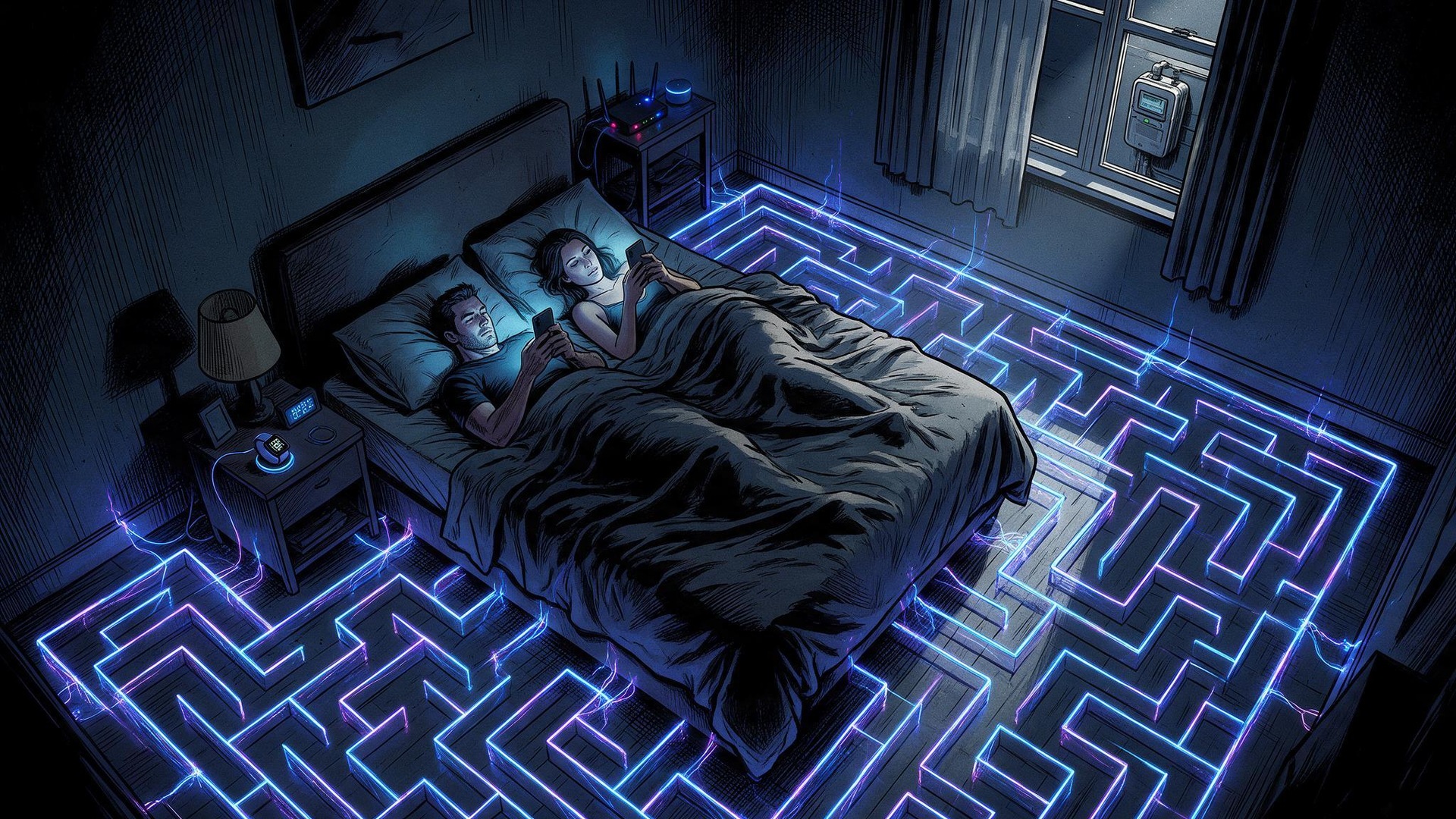
It's 11 at night. The house is quiet, the lights are off, and you're lying in bed with a phone 10 inches from your face. Down the hall a router blinks. Outside your bedroom wall, a smart meter checks in with the power company. On the nightstand, your watch is still talking to your phone.
You think the day is over. Your body doesn't. As far as it can tell, the sun never went down.
This part of the maze has no smell, no taste, and no label. You can't see it at all, and that is exactly why nobody questions it.
The bulb you were told to buy
In 2009, the European Union began phasing out the incandescent bulb, and much of the world followed. The replacements we were handed came with problems of their own.
Compact fluorescent bulbs, the curly ones, contain mercury, a potent neurotoxin. When one breaks, it releases mercury vapor into the room. The official advice is to clear the room and air it out, a step most people have never heard of. CFLs also give off low levels of UV radiation, and when they're thrown out, the mercury ends up in landfills and water.
LEDs don't carry mercury, but most of them are heavy in blue wavelengths, the part of the spectrum your brain reads as daylight.
The night that never comes
Your body runs on a clock set by the sun. When it gets dark, your brain releases melatonin, the hormone that brings on sleep and lets your body repair itself overnight.
Blue light after sunset shuts that signal down. Every bright ceiling LED and every screen you look at in the evening tells your brain it's still noon. The result is lighter sleep, less of it, and a body that never fully resets. Disrupted circadian rhythms have been linked to obesity, diabetes, depression, and cancer.
The flicker you can't see
Sunlight and candlelight are steady. Most modern lighting is not. LEDs and fluorescents can pulse hundreds of times per second, too fast for you to notice but not too fast for your nervous system.
That invisible flicker has been linked to migraines, eye strain, fatigue, and higher levels of cortisol, the stress hormone. Office workers under high-flicker lighting have reported more fatigue and more trouble concentrating than people working under natural or incandescent light. If you finish a day under office lights with a headache and brain fog, the lights may be part of the reason.
The haze in the walls
Then there's the part of the maze that doesn't come from a bulb at all.
Your body is an electrical system. Your heart beats on electrical signals, your brain talks in electrical impulses, and your cells depend on tiny voltage differences to function. Until the last century, none of us lived inside a constant field of man-made wireless signals.
Now we sleep in one.
Wi-Fi routers broadcast around the clock, whether anyone is using them or not. Smart meters send out pulsed radiofrequency signals all day and all night. Studies have tied long-term wireless exposure to oxidative stress, headaches, sleep problems, and reduced fertility. In one experiment, a Wi-Fi-connected laptop placed near men's reproductive organs damaged the DNA in their sperm. Children, whose bodies are still developing, are the most vulnerable.
Finding your way out
You don't have to throw out your phone or sit in the dark. Start with the room where you spend a third of your life.
Bedroom: keep the phone out, or on airplane mode across the room. Use a plain alarm clock.
Router: move it away from where people sleep, and put it on a timer that shuts it off at night.
Go wired: run Ethernet to the computer and TV, and use wired headphones instead of Bluetooth.
Bulbs: use incandescent or warm, low-blue bulbs in the rooms you use at night. Keep LEDs and fluorescents for daytime spaces.
Evenings: dim the lights after sunset and put the screens away an hour before bed.
Smart meter: ask your utility whether an analog meter is an option.
Distance: signal strength drops sharply with every few feet, so keep the laptop off your lap and the phone out of your pocket.
And get outside in the morning. Real sunlight early in the day is what sets the clock that artificial light keeps breaking.
This is Part 5 of 10. The full research is in The Maze of Poison: Book V – Artificial Light and EMR, free in the Red Pill Library. Protocol Media is building a complete archive around every topic we cover: books, briefs, music, art, and short-form video, backed by three records. The Evidence Record holds the primary documents. The Founding Record holds the Constitution and the founding papers. The Acts Record tracks the laws passed since, measured against them. That work is underway now, and this page will keep growing as it fills in.
ART AS THE WEAPON. TRUTH AS THE AMMUNITION.