
By Ghost Zero
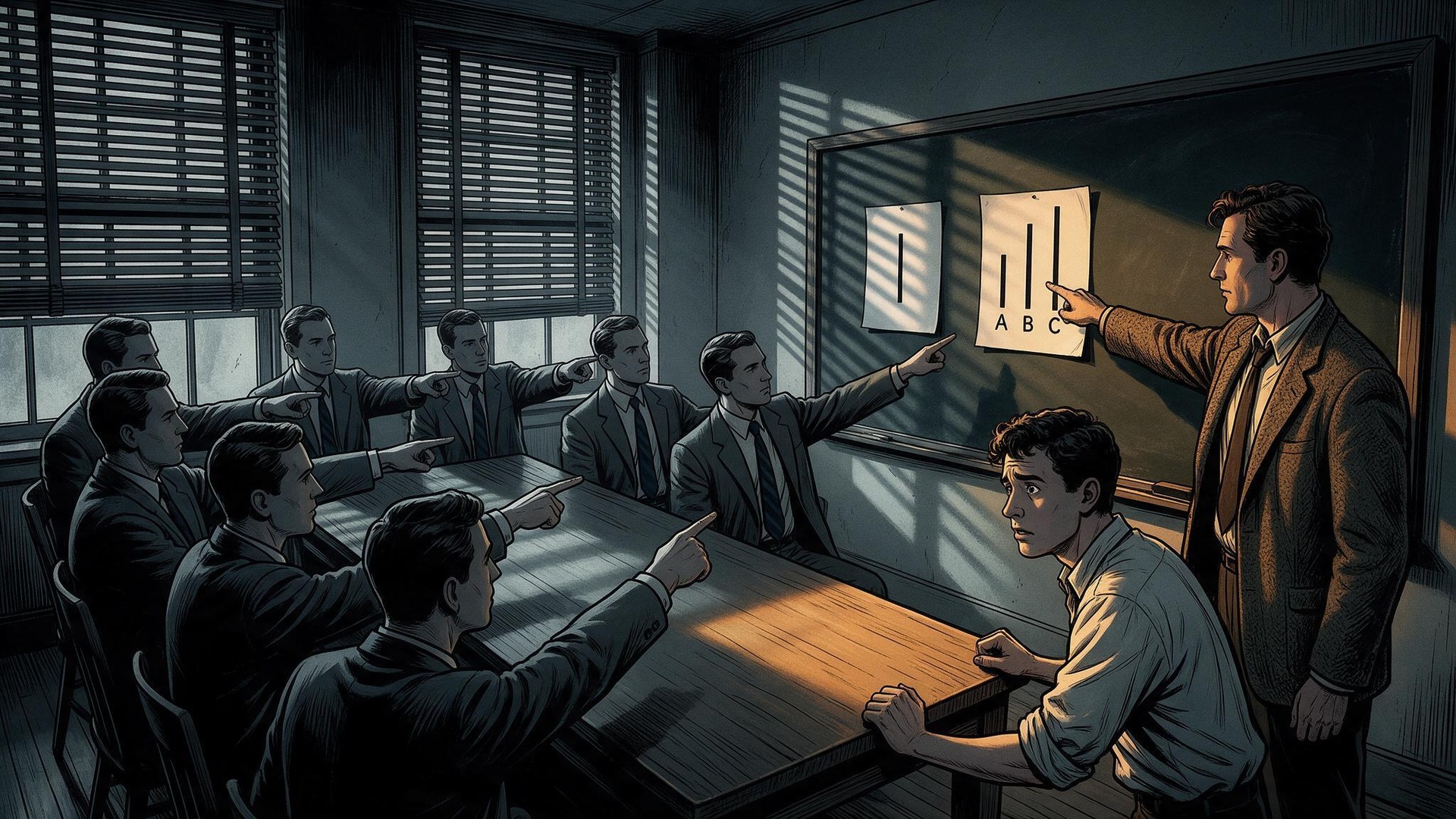
In 1951, a psychologist named Solomon Asch sat college students down at a table and asked them a question a child could answer. Here is a line. Which of these 3 lines is the same length?
Everyone else at the table was working for Asch. On cue, one after another, they all gave the same wrong answer out loud. Then it was the real subject's turn.
On their own, people almost never got it wrong. With the room against them, about 3 out of 4 went along with the group at least once. They looked at 2 lines that plainly did not match and said they did.
When Asch interviewed them afterward, a few admitted they had started doubting their own eyes. Most hadn't. They saw it fine. They just didn't want to be the only one.
The man in the gray coat
10 years later at Yale, Stanley Milgram tested authority instead of a crowd. A man in a gray lab coat told volunteers to give electric shocks to a stranger in the next room, stepping up switch by switch to 450 volts. The switches near the end were labeled "Danger: Severe Shock." The shocks were fake. The volunteers didn't know that.
The stranger yelled. He begged to be let out. Then he went silent.
26 of 40 volunteers went all the way to the last switch. Milgram published the results in 1963.
This is usually where the story stops. Leave it there and the lesson sounds like despair: people are sheep, the room always wins, nothing you do matters.
That is not what the research found.
The part they leave out
Asch ran the experiment again with one change. One other person at the table gave the right answer.
That was all it took. Wrong answers fell from roughly 1 in 3 to about 1 in 20. The subject didn't need a majority. He didn't need to win. He only needed to know he wasn't alone.
Milgram found the same thing. In one version, the volunteer worked alongside 2 other "teachers" who refused to keep going. With the room no longer unanimous, the number who went all the way to 450 volts dropped from 26 out of 40 to 4.
Read that again. The pressure that made decent people deny their own eyes, and keep pressing a switch while a man screamed, depended on one thing: everyone in the room appearing to agree. Break that, and the whole thing falls apart.
The script is strong. It is also fragile. It only works if nobody breaks it.
The smartest room in America
In April 1961, President Kennedy approved the Bay of Pigs invasion, planned by the CIA and reviewed by some of the most credentialed men in Washington. It failed inside 3 days.
One of the men in those meetings, historian Arthur Schlesinger Jr., had serious doubts the entire time. He said almost nothing. He later wrote that in the months afterward, he "bitterly reproached" himself "for having kept so silent during those crucial discussions in the Cabinet Room."
He wasn't the only one with doubts. Each man looked around the table, saw what looked like agreement, and kept quiet. The agreement was never real. It was a room full of people waiting for someone else to go first.
In 1972, psychologist Irving Janis used that exact case to name what had happened. He called it groupthink.
Today the table is a screen
Asch needed a room full of paid actors to make one person doubt what he saw. Today the room comes built in. It is the feed that shows you what everyone supposedly thinks. It is the comment section stacked in one direction. It is the expert panel where every guest agrees, and the friend group where one topic is quietly off limits.
The people inside it are not stupid. Most of them see it fine, the same way Asch's subjects saw the lines. They just don't want to be the only one.
That is what an NPC is. Not someone who can't think. Someone running a script because breaking it feels like standing alone.
Be the one
Here is what Asch and Milgram actually proved. You do not need to convince the whole room. You do not need a movement. You need to be the one person who says what is plainly in front of everyone.
Say it out loud. Ask the question everyone is thinking. Put it in writing. Refuse to press the switch.
Every room you walk into has someone in it who already sees it clearly, waiting for one other person to say it first. Every time you say it, you give that person permission to stop pretending.
You are not an NPC. You never were. And the room only needs one.
AWAKENING THE PLAYER is out now on every platform. The full research is in the book Awakening the Player: A Guide to Breaking Free from the NPC Mindset and Reclaiming Your Critical Thought, free in the Red Pill Library.
ART AS THE WEAPON. TRUTH AS THE AMMUNITION.